Showing posts with label Work. Show all posts

Sunday, August 7, 2022

Journey of Old Journals- 1983

This journal begins on the last day of my summer internship at the New York State Archives, where my main project was to rebox files from SingSing prison from the old to the new acid-free archival boxes. As I would review the contents, I would heft the larger files from the box to see how they began. Inevitably, juvenile petty shenanigans (at 8-13 years) escalated into larger and more serious crimes.  I looked at Julius and Ethel Rosenberg's telegrams received before they were executed and marveled over a handmade weapon resembling a circular saw.  In the end, I let without anyone saying goodbye; I was not supervised well. 


However,  I did a great job on a paper I had to write for the college credit, which explored the nuances of how the dehumanizing elements of the prison system perpetuated the trauma instead of being rehabilitative. I explored the Friends Alternatives to Violence Project and read prison notes from people who were published. I remember leaving my notes in a folder on the grass, losing the details yet being able to reconstruct enough to create an acceptable final product. 


I spent time at the women’s peace encampment in Romulus, New York, and was fascinated by the culture, bravery, and long, drawn-out discussions about nonviolent action. I also learned you could put a wooden platform beneath a tent and have a bed and dresser inside. I think I went back to Joslin clinic for more education. I remember traveling from Boston to Buffalo on a plane, writing about low blood sugar tears from a missed flight and the saffron-robed Hare Krishnas.


In the end, as I returned to school, my love interest at the time had found a new apartment and a new lover. My writing is fueled by betrayal, anger, hanging on, and the complicated approach of staying within a relationship because “monogamy is misogyny.” 


I ended with an observation, “I feel like I’m losing my leaves becoming bare, shedding a part of my life which has changed colors, dried out, and shall pass into a different stage.” 


Saturday, February 24, 2018

Returns

A major shift in Maine's fifth largest (and my former) employer occurred in early February. L.L. Bean announced that their 106-year-old "satisfaction guarantee" was generally limited to one year from purchase or to those holding a receipt. Resulting news was featured in local, regional and national media. A contributing New Yorker writer from Maine,Ian Crouch, wrote "Even if it seems to have failed as a business model, L. L. Bean’s return policy was treasured largely because it reflected the values and characteristics that we like to celebrate in ourselves and each other as Mainers, ones that we may not always live up to but to which we might aspire—traits like honesty, good nature, and a mind-your-own-business ethos in which asking someone to explain himself is tantamount to calling him a liar." Working at L.L. Bean was a right of passage, a common thread shared across all walks of life. The company builds its brand on Maine's beauty and rural character and had a great reputation for treating its employees well.  
Taking old slippers back was the worst part
of the job at Customer Service.
(AP Photo/Robert F. Bukaty) 


When I grew tired of the relentless and repetitive work at L.L. Bean's cash registers, I asked to be trained in Customer Service. The complexity of using multiple inventory systems seemed intriguing, and the esprit de corps of the team was strong. Just a month after I started the new position, management instituted "special conditions" into the return policy. These reasons to refuse (change in size for both children and adults, personal family reasons such as death, moving, divorce and accidents) were stealthily introduced. Signs disappeared overnight and new language appeared on the website. The customer service department explained the "clarifications" with every person as they placed their questionable item on the counter and responded to the reason for the return.  


Customers reacted. Anger, indignation, resignation, and "it's about time" were common. Dismay and disappointment resulting in tears or aggression were occasional but memorable. People lied. A man commanded the returns area with a loud treatise of "I bought this under the old policy and you should honor it" and was so determined to get his way that he escalated up three levels of management before finally left in a blaze of umbrage. The "clarification" of the policy seemed to be an affront to those who had scammed the system in the past, and now their annual "I want a new backpack." jig was up. 

As the line wound through the cordons of the stuffy cave, I would see people waiting and begin to fear the conversation that would ensue. I was always relieved to see the familiar green shipping bag that indicated an easy transaction. A woman arrived at my station, three girls under 10 years old in tow, and placed a pink sweater, with a small hole under the arm, on the counter. It was sized for an infant, and last sold in 2008. Then came the Red Wing work shoes of a style not seen since the 70's, a brand we had never sold. I could sense her desperation mounting, realizing her plans were dissolving with my response. She tried to retain a brave face in front of her daughters. I sensed that maybe things were not great at home; Christmas was coming. Her last item was acceptable for return and she went on her way with a gift card.  

As the media blitz has faded in the scope of recent news, I suspect that the conversations at Customer Service are much different. The end of the return policy is both a cultural and business shift for the company, and for Mainers. It was good while it lasted but now its no longer. Now, we wait to see how the pending class action suit resolves itself. 

Wednesday, August 30, 2017

Message from the Universe

Summer is ending and I am feeling wistful for what could have been. Looking back on a few meager Maine adventures and the week at sea, I’m a tad regretful that I worked so much over the past two months. As the sun rushes back to the horizon and the sunflowers stand tall and triumphant, the air has a brisk sense of crispness for the ripening of harvests and the beginning of foliage season.
The Great Pumpkin winner at the Alaska State Fair.
Grown entirely with hydroponics, the pumpkin weighed in at
1,231.5 pounds.  A tradition at the end of August in Alaska.
Instead of feeling rich with summer's bounty, I'm tattered, juggling and plate spinning on work projects. The retail job hired me part-time with benefits and increased my hours. I applied in the midst of the ACA controversy as the memories of the crippling costs of self-insurance in Alaska were painful. I don’t think that was a mistake to move to "permanent", but the tide is rushing with the consulting work as well.

There are three other concurrent projects on deck; good work with great people. Hours have become precious, scheduled, and dedicated to specific things: tasks, cooking, driving, and eating and sleeping. I was happily distracted to have two different houseguests who each came for day days for the third week of August, long-time friends who traveled long hours to get to Maine.


On a Sunday afternoon after the last guest had left, when I descended the stairs after stripping the beds, I missed the last step and sprained my ankle. Pain erupted; I heard something click. When the hubbub subsided and I R.I.C.E’d without relief, I headed off to the clinic. Nothing was broken, but the orders were clear. I couldn’t go to work at the retail job on Monday.
Photo from NASA.
https://www.doi.gov/sites/doi.gov/files/uploads/solar_eclipse_nasa.jpg


I felt a cascade of relief wash over me and called in sick.  I made a long list of things that had been bugging me to get done, and the next morning I ensconced myself into a comfy chair with an ice pack, knocked out tasks, made a pinhole box viewer for the Eclipse, and a plan to meet a friend for an afternoon at the beach to watch it. In the afternoon on the rocky shore, the tide drifted out, I shared my shadow in the bottom of the box with my friend and a young mother and son. I bathed in the waning afternoon sun, taking nourishment in the sea air. It was a wonderful moment to be celebrating nature's power with other Americans.

In accidents like this, the message from the Universe is clear. Slow down. Pay attention. Use your support system (the railing). There’s plenty of time if you bring intention to each minute. It was a wake-up call, a reckoning, a realization that I'd like to dedicate more time to walking and nature and exploring new places. That will happen right after I wrap up short project #2...

Monday, May 29, 2017

Stability in Mud

I was standing ankle deep in soupy mud on the Appalachian Trail feeling right at home in the woods, but a bit different in the group.  I'd joined a group of employees from the long-standing New England retail brand for which I have been working for the past 8 months.  It was rare for a seasonal, on-call employee to join these bi-annual work parties; the average tenure of the small group was over 15 years of consecutive service.  

 I'd joined the trip to shake down the camping equipment that had been in storage for the past 6 years, get re-acquainted with New England forests, and meet new people. It was a cheap, life-affirming foray into my old self, but it also awakened the tension between my love for the flexibility of a consulting practice, and a tinge of envy for steady work and benefits.

Earlier this month, I read Joseph Williams's essay recounting of his stint as a retail worker. The article hit a couple of threads for me: the feeling of desperation in applying for retail work, his practice of dumbing down his resume to get a job, and the moment when a classy, recently retired bureaucrat female comes into to the store. 


"As I fitted her for shoes and checked her stride, we struck up a conversation about politics, finance, and the fact that not a single Wall Street banker had ended up in jail. Then, Jan hit me with a question I hadn’t considered in the months since I hustled my way into a job I didn’t want, had to have, and had come to accept.  

“So, Joe,” she asked, “What is it that you really do?”
I paused, slightly taken aback. I sell shoes, I told her. That’s my job.
“Yes, I understand,” she persisted. “But what do you really do?”
By that point, it was clear what she meant: Why are you here? " 

I am feeling loyal and grateful to be involved with the business even if the hourly wage is meager.  It's another decent gig in the ball-juggling of my work life right now, and that's ok. My colleagues on the floor are good, solid, happy, and intelligent people to work with. Some have been in long enough to be able to secure the benefits package with flexible, part-time employment, a boon for the real estate agents, financial advisers, house cleaners, artists, and gig workers behind the counter. I wonder if I'll make it into that category, or if those are days gone by. 
A temp job for May: collect and maintain
inventory for a plant sale. 

In the carpool to the trailhead, I heard the stories of wellness programs, new computer systems, learning opportunities, and supportive office dynamics.  I didn't mention that my employment juggling has reached a new frenzy this month with securing a short-term event management contract. I was running so hard in the days before the trip that I forgot to pack socks (I remembered the liners, so that worked), made a rash decision to forgo my cookpot (used the big pots provided instead) and realized, on my way to to rondevous point, that I we were taking my car and I'd neglected to it properly tidied up for the 4-hour drive to the trailhead (it didn't matter). 

While hiking through the forest to start the first day's work on the Appalacian Trail, I reflected on a trip of days gone by from Alaska. For a few years, I went on trips with Wilderness Volunteers in the spring time, largely seeking cheap and meaningful ways to escape break-up.  

I flew from Alaska to Phoenix and hiked up a mountain in the Tonto National Forest the next day. My breath was labored, the backpack loaded with too much water, and I was plodding along at the end of the pack. The trip leader was concerned. "I'm having Beluga Factor.", I gasped. The concerned group of slower hikers looked at me quizzically until I explained that I was suffering from the transition from cool ocean to hot desert, and everyone laughed. 
Much of the work involved clearing drainage
areas to help reduce the amount of mud
on the trail. 


Indeed, this work party was also a milestone: one year back in the U.S., a chance to bond with corporate, and form a connection to rich, dark forest duff, the delicate painted Trillium, the grunt and heave of a shovel and the beauty of a gently upwelling spring.  I was touched on the final night, when I recieved a "first-year" pin and a hug for participating. 

Now, I need to stay focused on living this life in full, not in envy of benefits or in fear of work uncertainty, but in the rich unfolding of this life stage and the honor of checking the box that says, "55-64."


Sunday, April 30, 2017

War Stories from Work

In April, I turned 55, officially launched a consulting practice and experienced yet another shifting of my workaday Universe. There was a week of waiting, after 3 interviews and reference checks, on a part-time job that I was excited about. In the same timeframe, there were two unexpected and "leaving in 2 weeks" resignations at another organization where I have been involved.

The people left with tattered spirits. There was a myriad of circumstances in their transition. Both were burned out and frustrated by organizational dysfunction and mismatched expectations. They tired beyond words. I found myself skirting their presence, recognizing the tell-tale signs of mission-driven work gone wrong. I'd seen it before-- both in myself and in others.

https://www.pinterest.com/arttxalliance/art-the-brain

I willingly admit that I have baggage. The litany of experiences that I've gained in the seven jobs I've worked and many other clients since I started professional work in 1998 have honed my skills, but also generated some scars. Last year, after I regrouped from my experiment in Boston employment, I created a list of all of the transitions I've endured while working full-time in organizations:

2 times welcoming a new Executive Director 
4 office moves 
1 death of a colleague
2 near-misses that could have resulted in a public relations crisis
1 loss of a major donor's funding that (I came in weeks after it happened) 
1 layoff 
2 cases of severely absent leadership
the year I submitted eight w-2 forms with my taxes

When I returned to the US in May,  the main goal of this next step was to work with happy people in a perfect job- a position that was dynamic, flexible, growth-oriented and fun. I found opportunities and organizations that sounded good on paper but that never called me in to discuss. More than once, I was interviewed because the committee was interested in my background but already had other final candidates. I applied for jobs even though I was overqualified. I keep hustling because one never knows in a small town like Maine what connections will come.  But there are times when I find it wearisome.

This process of continued searching tests your mettle. I've lost and regained confidence and made a bit dent in my savings despite Obamacare subsidies and frugality. I continue to reach out. Launching the website and the business made me connect with the person that I am. The one who shows up just at the right time to move organizations through whatever transitions they are experiencing at the time.


Saturday, August 20, 2016

Work Ethics


I thought it would be over by now.  I thought that within 100 days I would have had a job offer and have started the process of building my income again. The deadline has come and gone: a relay baton not passed or a left-hand turn in the car passed too quickly. My life passed by with both a blink of an eye with time both inexorably slow at the same time. 

In recent weeks, the void of paid work in my life has been a lingering dissonance, like the empty patch in the garden from a large plant that I relocated a few weeks ago or the annoyance of a typographical error on the sign near the cashier.  Characteristically, I am keeping busy attending to life details, getting out and about in wild places, conversing with a network about who I am and what I want to do, and undertaking  projects with a couple of groups that were close to my heart and were happy to have a seasoned consultant offer free services for a limited period of time.  My New England work ethic has always defined my character by what I do, but here in America your professional job typically provides you with other benefits- health insurance and sometimes an ability to invest tax-free.
http://image.slidesharecdn.com/Max Weber 

At this 100 day milestone, I am facing the need to refill those critical medicines I need to survive. I'm not clear of those costs and with a $5,000 deductible looming ahead for the next three months, all expenses are mine to bear. Fortunately,  I am receiving a low-income subsidy for the monthly premiums and I have virtually no living expenses while staying with my parents. I am grateful for that.  While I have grown to accept many of the facts about managing my diabetes, it pales to the reality of my grandfather. 

I had an opportunity recently to read my uncle's family history about my father's father, George.  My grandfather was diagnosed with Type 1 diabetes as a young adult just after insulin was discovered in 1922.  He lost his job during the Great Depression and went to the library to hide the fact that he was unemployed. George found a job working with a steamship company in Boston, but he could never reveal that he lived with diabetes. He could never buy life insurance for his family. He never went out to dinner with friends or colleagues, in fact eating the exact same food each day: oatmeal for breakfast, ratatouille for lunch and meat and vegetables for dinner.  He was so scarred by the Great Depression that they never bought a house and he saved all of his money in Swiss bank accounts-- a secret kept from his wife until he passed. 

Today, I often cycle past the 2 apartments where my grandparents lived in Brunswick (they were displaced twice by Bowdoin College's student housing expansions.)  My father's great-grandfather was born in Nova Scotia and started logging in Brewer Maine at 16. At 22, founded one of Maines's larger lumber companies, which harvested vast tracts of timber and floated them down the Penobscot River to the waiting ships that clustered in the bay to transport to market.  The family has always worked hard. 
At the Oak Hill Cemetary in Brewer Maine.
Photo credit Bill Maling. 
I finally buckled down and applied for a seasonal, temporary job at a major outdoor retailer a few weeks ago.  

 "Have you ever worked on a factory line or around heavy machinery?", the interviewer asked.  This question came just a day  after a search committee for a senior level position asked about my project management skills, to which I replied, "Plate Spinning" and the interview team erupted in laughter.   But here I was in a cubicle with the interviewer typing into an online form while listening to my responses. 

"Yes.I have", I replied.  The factory was my first job after my freshman year of college. It was the first time that I met someone who had lost most of her teeth. Her think hair was pinned on a small bun atop of her head. She told me about her love flower over the clatter and dusty of the machines that spit out sheets with tiny glue squares, upon which we glued a petit four of small fabric squares. The country radio station played, "I'd rather be lonely without you than a fool by your side."  I realized the power of being born into the middle class and the power of health insurance.

Weaver Bird and Nest
http://4.bp.blogspot.com/
These days,  I am spending some of my days a the library. The full-time job search has thus far been  unsuccessful.  10 closely-targeted senior management level CV submissions and three interviews later, my internal dialog is beginning again about my uneasy relationship with office work. How to be a creative freelancer with the Ball and Chain of healthcare costs? This is a recurrent refrain from the opening number in my performance art piece in 2010.

I am so grateful to have this unique position.  As long as I can manage to wrestle the internal doubts and idiosyncrasies of living with my parents, this is a great place to stay. There are minimal financial obligations. I have savings after years of living on the very cheap.  Last week when I refilled the prescriptions, it was a huge relief- Obamacare is working for me.  I think I can pursue a creative path.

This process of forming relationships, establishing structure and creating a new life will take longer.  I can feel the webs forming, the tensile threads of connections, a glistening and resilient network that forms community and work connections.  I am building a nest, gathering threads, knitting together small balls of yarn to create the blanket of this new life.  


Sunday, January 24, 2016

Safety vests, Helmets and Flip Flops

My experience in Phnom Penh is in part defined by the sound of metal on rock. The young man taking a small power drill to loosen the smooth concrete on the sidewalk contrasts with the huge jackhammer mounted on a truck, taking out walls with the repeated blow of a thick and narrow blunt instrument. On one project men stood atop walls of an old colonial building with sledgehammers, beating down slowly. Just this morning the worker with the grinder was smoothing concrete edges, showering dust and small rocks onto the hallway outside my apartment door.

Screeching. Whirring. Rumbling. Huge machinery with rapid-fire pneumatic bursts. Over and over again, the destruction of rock by a single point. While before I was witnessing sites as I walked or zoomed past in tuk-tuks, now I have active construction sites near both work and at home.
From the elevated walkway at the hospital,September 2015.

The same view in January 2016.


A couple months ago  the owner of the building behind my apartment (it is so close I can touch it as I turn into the door of my apartment) and the Ministry of Health right next to the hospital both decided to launch major expansion projects. The noise ranges from a relatively pleasant hammering on wood to the long steady grind of an engine. The shouts of workers and the  pounding, screaming and general labor of drills are now normal. Last week, the workmen at the hospital repeated dropped rebar and metal supports that clanked and crashed, adding a whole new punctuation to the work day.

These trucks show up around town every d
The dust is omnipresent and gritty; a fine fairy dirt that leads to bouts of sneezing; daily dusting is warranted but I have limited energy for it. On the streets, it's common to see the combination of concrete pumper and truck extending high into the air. the two massive front wheels lifted off the ground and the pipe extended high into the air, filling pilings of rebar.

  What I wrote abou18 months ago has only increased in frenzy. In  BKK1, a dignified neighborhood that was the enclave of expatriates and tycoons, a lovely old wooden house with prolific palms and hanging orchids stands beleaguered, surrounded my concrete construction sites on all sides. A “For Sale” sign is displayed prominently, perhaps a notice of mounting frustration or just speculative hope. Throughout the city, some sites are busy and others are waiting for the next cash infusion.

A roof replacement of an old
Colonial building. 
Cambodia, and Phnom Penh in particular, are in an unprecedented building boom. Investments in construction increased to 3 billion dollars in 2015, a 30% increase since last year. In the first half of 2015, Phnom Penh city received notice of 694 construction projects of which 90% were "high-rises" intended for the wealthy.

I always look for the workers. They labor in dirty clothing, hats and scarves that cover their heads and faces. They relocate from their rice fields for the cash, grateful for the $2-$5 a day they may receive. At the site near the hospital, their helmets are perched atop, the reflective safety vests gleaming in the afternoon sun. Their feet, in simple flip flop slippers, are vulnerable as they rest on a grid of rebar waiting for the concrete. The dude in the button-down shirt shows up once and a while, but nothing seems to change except the height of the building.
Pool closed for 3 weeks while
they painted at the gym. Bamboo
scaffolding secured with plastic
ties is the norm here. 
While most are working during the day, there are some that labor into the evening. The bright burn of welding flashes and ebbs in the darkness of the site, shadowy men swinging around on the scaffolding. A friend complains that the site near her has allowed an all night shift; she has not slept well for months, Communities of workers make do on the ground floor of their workplace, where they camp out during the construction. They hang laundry, sing in the shower on the street side and play cards on simple wooden platforms by the light of a single lightbulb. The toddlers play naked in the sand piles, one holding an old drill bit in his mouth like a cigar.

This rapidly developing Phnom Pen has been heralded as the advent of the next golden age for this tattered country. There are concerns about a bubble: who will live in these places?  is this rapid pace of growth sustainable? Like many of the shiny new buildings, this rapid and shoddy development masks the inequities of corruption and exploitation. My visitors exclaim, "Phnom Penh is booming!" 

These buildings are built on the back of poor people. With a worker's life valued at $2,500, it is easier for the bosses to pay the families than it is to implement safety standards. The tycoons and investors are rich with hope and optimism. The poor will take their meager cash back to the province. This is the cycle of life in Phnom Penh for now.

Just yesterday,  I noticed these large palms on the roof.
Are they comfortable there so close to the sky? I don't think a crane hoisted them up,
they were likely carried up the stairs by strong young men.


Friday, March 27, 2015

Total System Reboot

The feeds appeared on my friends' Facebook statuses around the 20th of March. It was the trifecta of astronomy- a spring equinox, a lunar eclipse and a supermoon.    There was conjecture that a new energy would emerge as the zodiac cycle moved into its last degree and started anew. Mystics proclaimed that is time  to feel the energy of change and new circumstance.  Tides were high, the earth and sun and moon interacted in dynamic ways. So why not embark on new steps and reboot life, start over and begin again?
http://www.elephantjournal.com/2015/03/march-solar-eclipse-total-system-reboot/
 I made the official request to reduce my work hours, effective 1 April.  This has been discussed since December and slowly I have been shedding staff who report to me.  Now, I only have to oversee 3 instead of 7.   Reports and budgets will be replaced by inviting people to support a cause I care about, crafting a strategy and tactics for engagement. Hopefully bringing more resources  in all forms.  I will be in the office 4 days a week, with one week a month for  only three days.  I will come in later and leave earlier.  I will ignore the work emails after hours.  I will use my extra space to create. Describe. Exercise. Eat more vegetables.  Have mental space for human conversation that is rich and meaningful.  Work on the writing project that has been on my mind since 2011.  The horizon appears richer, filled with potential and light.

A glimpse of the inner workings of
the public works system,  The new drainage
pipes  are juxtaposed against the
old system built by the
French in the 50's.
Not a great smell from
that black water! 

The blush of January and February's fresh air have now left, filled with the residual vestige of a slight breeze in the morning.  We are now in hot season.   I am finding the smells around town a bit oppressive.   The noxious fumes of the ill-maintained diesel truck mingled with the small puffs of moto exhaust on my leg in the traffic.

There's a clear piercing aroma of dust as the  young man stands strong and tall on the first story remnants of an old Colonial building, swinging his sledgehammer and knocking off brick by brick all day. Perhaps the developer likely couldn't schedule the machine to do it, or the boys were cheaper.

The waft of the trash that has rested too long in the street in the early evening, where on the outskirts of the city, the cattle will wade their way through the plastic and forage for leftovers.

I can smell the faint aftershave on Mr Picadeh (my regular motodup) in the morning or the beer on the tuk tuk driver's  breath on a late Sunday afternoon, I politely decline a ride from the would-be driver and his friends laugh as he returns to the card game. A babe swings in the hammock under the shade of the tree as.the nonplussed mother observes me and touches the bulk of her fanny pack filled with cash and phone cards from the day's sales.

From the article printed in 2012: Women irked by men who urinate
in public.
The article quoted one Cambodian woman who urged men
to find a toilet. Like women have to do.

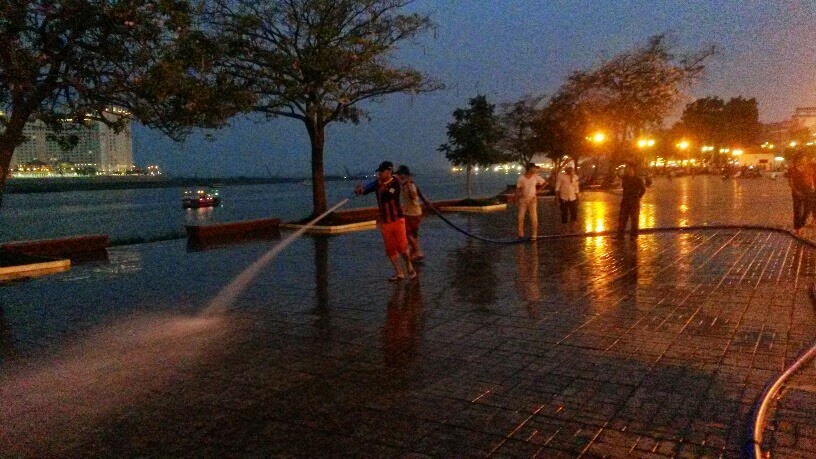
The smoke of a charcoal fire from the neighbors below wafts  up to my kitchen window and I can hear the girls chattering and the thunk of the cleaver chopping vegetables when I do the dishes. There's an occasional wisp of a perfume of lovely young girls strolling the promenade of riverside, juxtaposed against the acrid smell of stale urine accumulated  from the habits of men in this country.

After a particularly effluent evening walk, I was glad to
see the boys having hosin' er down. Now, for the rest of the city. 


 The water in the river now appears a nearly sea green hue and the rice fields in the highways are brown and fallow, the occasional ibis rummaging for crickets or mice.I find myself longing for the rain, hoping to relieve that holding pattern of drought. Find something to wash the city clean and water the fields and have the verdant grass come again.


Thecoming days will bring this change.  And I will have the space and time and energy to dedicate time to craft.  A new relaxed attitude.     A commitment to to churn through my creative process and see what emerges.


Tuesday, January 27, 2015

Sales on Wheels

 Ratha, my friend the noodle seller, was upset.  For the past few years, she sets up a food cart in front of the school across the street.   She had a decent business and a social network.  Then the city built a new police station.  The grass surrounding their new stucco building was barricaded with crowd control fencing protecting their pristine white motorcycles.    One night I noticed a gauntlet of public service employees ranging from lower-level neon vested minions to jackbooted and armed officers who were shaking down the SUV's.  "Ah." I thought to myself, "The boys need a new flat screen for the station."
This woman shows up in front of my apartment each
day at 4pm. I usually only see her on weekends.
 She fries a rice flour cake with minced onion
over a small fire. 
The vendors were told to move.  Ratha reported that the police were saving those spaces for their relatives' businesses. There was some mention about doubling the street side rent. (Mind you, there are no permits, there is only payoffs to local authorities.)  She was worried about the change and  considering other locations to take her metal cart on wheels.  Change this big is huge for these poor Cambodian vendors.  It means navigating a new landscape, relationships and power dynamics.  She was understandably fearful.

The street vendors are everywhere.  Sellers are on a schedule. They have established routes, times that they typically show up in places and they stick to their inventory because it is known and trusted.  To change could mean a potential loss of income.  The people who use  bicycles and push carts for selling stay low on the class structure, vulnerable to the vagaries of those in more power who want a parking space for their SUV.  They navigate traffic, pushing a cart with a smoking grill through the cars on the way to their next stop.  They are one step away from an accident or a crisis and the ensuing descent into loan sharks and poverty.
My favorite. Women who bicycle
with donuts in the case. Such a beautiful
portrait and she insisted on giving me the
donuts for free.

The development and change are everywhere yet the street sellers seem to prevail for now.  When I returned from the trip to Disneyworld, the small grassy park next to my house was covered with bricks and turned into a parking lot.  Fortunately, they kept the trees.  For weeks before, I'd been thinking I should have photographed the cyclo drivers who often napped there in the shade or laid out their laundry on the grass to dry.  But I didn't.  Now they are gone.

Fruit sellers who provision at the larger market
and stop at locations around town to sell. There is a lot
of entrepreneurship happening outside the hospital where
this was taken. 

Not only food!  School uniforms!

And cleaning supplies! (Siem Reap)
Ratha has found a new location on the street.  She's happy in thinking she can sell the noodles to the tuk tuk guys, who hang outside the supermarket next to my apartment and frequently use the public washroom and running water for their moto engines. There's a set up with a guy who does tire repair, has an air-compressor and gas for sale there, the other sandwich seller that also was positioned near here in the former location,   For now, her life is restored.  


Monday, November 11, 2013

Equilibrium and Equanimity

There are days when “too much work” is exemplified in the moment the Spanx™ are peeled off in the work bathroom after the sun has set and the birds have begun their evening flutters in the hospital courtyard.    My epic day was, in fact, somewhat typical since returning from my writing retreat nearly a month ago.  

An early morning meeting with major donors and the VP from the states (hence a nice dress and tummy control), then diving into a 90 minute power-write into a proposal for a new TB case finding project (rebuilt ambulance for mobile chest x-ray into villages yeah!) while at the same time battling confusion around the baffling prevalence numbers from the national TB program.  A quick jaunt across the street for a the usual 75 cent lunch and visiting with international volunteers who were hanging out in the break room shortly after.  A coaching meeting with a colleague through the draft of his grant report (why does the word “has” come up every other sentence?), trotting over on my third trip across the street to the social enterprise clinic for a photo op with a Cambodian donor/patient and topping it all off with an all staff meeting where my close colleague was selected as Employee of the Month and the executive director announced his resignation.
The team decided to implement certificates instead of thank you notes for our Cambodian donors. The frame indicates a large gift.  This donor's son was trained at the hospital and she's been coming to us since 1999 for outpatient care for Type 2 diabetes.
Work is consuming my life; and for this I am resigned and a little resentful,  tired and hopeful, nostalgic for the days of yore and wondering how many times in my life I have to re-learn the same stress management lessons.   My job is a fantastic opportunity to advance an organization’s local capacity.  I’m getting paid reasonably well within the organization (but not within the market) and learning each day.  When the supervisor/colleague left in June, my position grew beyond project development, grant writing and grant management to encompass fundraising and communications, and overseeing 6 staff including a part-time western IT consultant working on an analysis of our medical record database. 

 Some work days are a roller coaster of  nagging, pervasive malaise and exhaustion, occasionally surging into an overwhelmed helplessness and moral indignation.  Other days dissipate back into a relatively manageable sense of being busy, productive, needed and appreciated.  This persistent problem of getting overly involved with work, sometimes leading to mental and physical breakdowns, has been a constant thread throughout my life.  Like the elbow of the blind masseuse that grinds into my cement shoulders to try and gain some flexibility, my pattern is that I often take drastic measures when my inner waters get too turbulent.
So little time...

I left an emotionally intense job doing social work on the streets of Boston in the beginnings of the AIDS epidemic to work my way around the country for seven years. I found peace in the great physical work of guiding on rivers, oceans and forests, and spent winters knitting beautiful hats while working at the front desk of hotels. I moved to Anchorage, bought a house and got my first real job. That involved the transition of two executive directors and an office move.   I fled to graduate school after turning around a failing consulting practice after the tragic death of a senior consultant from a brain tumor.  Eventually, although it took several years, I left for southeast Asia.  That radical departure was set in motion after managing an organization through a forced headquarters relocation that involved moving  50 staff who had been in the same building for 20 years, while designing and securing donations for the new space and preparing ground work for an ultimately successful capital campaign for a summer camp renovation.  (One summer at camp, we had problems with a pair of adolescent grizzly bears who wandered through periodically and thus I found myself thinking about shotguns and rubber bullets.)  After leaving that job at the advent of the great recession of 2008,  I supported myself with consulting projects and stressed over health insurance costs that equaled a monthly mortgage payment. A seemingly god-sent ultimate real job resulted in  a mystifying, byzantine power play and a pink slip. The dog died and my love affair with Alaska ended. 

So, now the challenge remains as I wind my way through yet another office job and organization in flux. I have only been in this position for nine months and thus,  for survival's sake, find a way to manage my stress and  find the balance between what I “should” do and the what would make me truly happy. Or at least identify how I want to spend my time here.


The “should do” category becomes a bit more looming after 50.  I’m at the place where financial planners dread. Living with diabetes has its expensive obligations of self-care. The life work I've chosen to do--standing beside the hurt, marginalized and vulnerable—has never paid exceptionally well.  I keep my expenses down, fastidiously saving for special things.   The reward of the stable monthly check in the bank account has its concurrent equally draining obligations.  Every day is a tornado of problems, needs, things to be written, budgeted, explained and the vast chasm between a far-reaching vision of what could be with the crushing reality of what is.  I have little spirit left for my creative self, and that makes me longing for imaginary greener pastures.
Heads of Hevajra and Four Dancing Yoginis, 
from the Metropolitan Museum of Art 
“God brought you to us,” my colleague said when she left in June.  “and you need to take care of yourself.  People like you, without a family, have a harder time setting the limits.”   The juggle of things that keep me awake at night coupled with the small agonies of living in a developing country and a very real lack of work support system does not make it easy here.  I'm laden with obligations given the substantial organizational investment in my salary; I work well past the time that my expat colleagues (Christian volunteers)  gather for their late afternoon carpool home.  I am the only staff person, besides the doctor on call for a very sick patient, who has non-negotiable deadlines for which failure to adhere has some  implications.  Hence the labor in the office after dark.

“Doing what it takes to get ‘er done”  has been my professional mantra of so many of my previous jobs.  Yet in a country where not accomplishing much in your desk job can be a national sport, being too stressed out among colleagues is definitely not culturally appropriate.   The wrist brace I've taken to wearing again to help with computer fatigue generates concern among staff, to which I have to reply- "really, it's just like a shoe for your hand!"  Clearly, some adjustments are needed; I started seeing a western physiotherapist last week.      

I'm finding that is the small shifts in perspective, repeated over and over again, that make a difference. Some of them, with the physio's help, need to be guided and repeated.   Adjust the posture at the work station. Hope for the best for the three giggly girls as they speed into incoming traffic. Have gratitude for the gifts of experience both positive and negative. Remember to smile at everyone.  Suck in the gut, lower the shoulders, and walk away from the keyboard.  Surround the listless baby in the begging women's arms at a major urban intersection with a fierce swath of virtual love and protection.   Reach out to a growing circle of friends and acquaintances.  Recuperate often. Breathe.

Every day is a new beginning, much like the newly emerged coconuts I saw on the motorbike taxi commute on Friday. In a swift lean in around the curve while seated sidesaddle in the fresh air of morning, I glimpsed it emerging from the top of a tall palm: tawny and rich with a hint of red, shiny with promise and potential of sweetness to come.  

 
Andy Goldsworthy, via Smithsonian

Sunday, June 23, 2013

Burning the candle at both ends

http://alongthewaytj.wordpress.com/

I giggle every time I hear the squeaker of Phnom Penh’s “etjai” (garbage collectors) heralding their arrival in the streets in the morning, but their jobs are anything but funny.  They patrol their routes throughout the day, picking through the trashcans or stopping in the middle of neighborhood alleys to collect cans, cardboard, and plastic water bottles.   Every in the heat and traffic, covered from head to toe in large brimmed hats, long sleeves and flip flops, they tow a large cart. Mothers bring their toddlers, who stand in the front of the cart in the early morning and then take a nap as the load fills up during the day.  It’s work that never ends and it pays them about $2 each day. 

Cambodians let little go to waste and the sensibilities about resources are prevalent in everyday life.  It is not uncommon to see beggars and etjai raking through large mounds of garbage that are piled up on sidewalks in the evening.   Hotel rooms have “locks” on the power switches that are activated by a room key, avoiding the problem of leaving the room with AC and the lights on. The printer in my office has refillable cartridges on the outside of the machine. 
The dry erase markers in my Thai classroom were carefully filled with an ink that managed to create small stains on most of my uniform shirts.  Shops to fix sewing machines and  motorbikes line the streets of certain neighborhoods.    I passed a motorbike trailer carrying large bins of food waste through the city streets, likely on the way to feed pigs and chickens somewhere on the outskirts of town. Last week, I saw a young man with repairing a fan in the alley below my apartment, his toolbox strapped to the back of his bicycle.

That said, are contradictions.   The tuk tuk driver will take the long way to keep moving through traffic as opposed to just sitting at the light and cutting the engine.  Old trees are revered, yet I’ve heard stories of the Prime Minister ordering the removal of them because the poor people camp often hang out in their shade.  In general,  the government has little issue with demolishing old growth forests for Vietnamese rubber tree plantations.  I know of an expat who blasts the air conditioning at night just so she can snuggle under blankets. The trash piles are filled with disposable food containers, organic waste, and millions of plastic bags.  The river is rife with plastic detritus.  The rainy season is upon us, and the street in my neighborhood floods with after torrential rains, resulting in overflowing storm drains that are rumored to contain sewage waste. 

I’m backlogged myself.  It has been a long time since my last post.  I was underwater in deadline and project management, working long hours and losing my connections with people and place here.  Language lessons and daily walks have fallen by the wayside both in work deadlines and the uncertain skies above. Storms come in moments now, blustering in on escalating winds and drenching rain.  

I’m balancing the idealization that I will be here for a relatively short period of time (I’m committed until early 2015) and not wanting to invest a lot in home and hearth, yet also longing for my beloved cast iron skillet and the crisp fresh air of the Alaskan summer.   I'm saving money for the next stage and thus don't want to spend a lot of money on rent, but there are times when a little AC would go a long way.   I dream of the expat apartment buildings with a resident gym and pool.    I’m torn between thinking about all that needs to be done in the present moment and pacing myself for the long haul.  I realize how hard it is to consider ongoing self-sustainability at the same time one is faced with pressing needs.

These are the lessons that I must learn over and over again.  Last week’s project deadline left me in a state of physical and emotional tatters, bruised and battered by "race to the end" tensions, inter-departmental conflicts and overwrought self-expectation.  The dry season's heat, Phnom Penh's escalating power needs and a power supply battle with Viet Nam have resulted in frequent power outages throughout the city.  At the hospital, in the heat of the afternoon, the generator rumbles to life to compensate.  The surges and fluctuations stress the equipment;  this year's generator use is unprecedented   The fuel costs are unbudgeted.  

There are reports of the crazy things happening in Alaska.  The winter lasted until May and now record breaking heat in June.   The increasing notices of melting, drought, fierce storms, smog, coupled with the frequent reports of environmental degradation all over southeast Asia and the globe has me  worried.  There is so much in life that is out of our control, and the small actions seem to be hopeless in the face of the enormity of action needed to right the balance.  

On Friday, I was happy to make an executive decision to call in sick to work and spend the day in my pajamas, feeling the breeze of the fan and the light rain on the metal roof just below my terrace.  After cleaning the house, I brought my stockpile of aluminum cans (created from drinking too much beer in an attempt to "manage" the stress of last week), to the etjai.   These are the small gifts we can offer to each other in the world. If we are going to go out in a blaze of consumptive glory and widespread denial, we might as well do the small things to be kind to each other and notice what's important.  

To be completely and totally focused on the gifts of each day and the small whispers of nature that permeate the city life.  The sound of the crickets who seem to appear from nowhere in the night, the flittery birds around the barbed wire around the fence next door and the stately, resource-rich palms that dot the riverside.  

For indeed, it is the small actions and notices that matter.

http://www.theage.com.au/